

Part Three of Neurodevelopmental Disorders!

Part Three of Neurodevelopmental Disorders will cover disorders of movement.  These include Developmental Coordination Disorder, Stereotypic Movement Disorder, and Tic Disorders, all of which are discussed below.

Click HERE if you would like to review the blog that introduces this series on Mental Health Diagnoses!

Developmental Coordination Disorder

Clumsy, awkward, and ‘all thumbs’ are typically how people describe someone who lacks coordination.  While we have all experienced moments of disharmony, for some, lack of coordination hinders daily functioning.  In these cases, it is necessary to consider whether or not the individual has Developmental Coordination Disorder.

Developmental Coordination Disorder is characterized by the impairment of motor coordination.   This can be ‘tripping over your own feet’, trouble standing on one foot, difficulty using scissors, and/or problems tying shoelaces.  Developmental Coordination Disorder also includes slow and inaccurate motor skill functioning (Diagnostic and Statistical Manual of Mental Disorders, 2013).

Criteria for Diagnosis

Diagnosis requires a detailed developmental and medical history, a physical examination, and assessments of the individual while they are in multiple contexts, such as work or school.  Multiple assessments and a detailed history are needed because an individual may meet motor milestones such as crawling and walking, but they may also be “delayed in developing skills such as negotiating stairs, pedaling, or buttoning shirts” (Diagnostic and Statistical Manual of Mental Disorders, 2013).

The individual’s motor skill impairment must significantly interfere with their daily activities:  getting dressed, using tools, and participating in group physical activities.  Developmental Coordination Disorder can manifest in either gross or fine motor skills.

Stereotypic Movement Disorder

There have been several memes, gifs, and short videos circulating throughout social media with the caption “always on beat”.  The clips usually show a celebrity rocking back and forth as though they were in sync with music playing in the background.  It is possible that the individuals shown in these clips are simply rocking to the beat of a song that is stuck in their head and not that they are unable to control their movements.  The inability to control repetitive movements, such as rocking side to side, is one of the characteristics that describe Stereotypic Movement Disorder.

Stereotypic Movement Disorder is “repetitive, seemingly driven, and apparently purposeless motor behavior” (Diagnostic and Statistical Manual of Mental Disorders, 2013).  While there are many examples of stereotypic movements, individuals with this diagnosis typically have unique or “signature” movements.  Some of these movements are classified as ‘with self-injurious behavior’ or ‘without self-injurious behavior’.  Movements such as eye poking, biting, and slapping are examples that would require an individual be given the ‘with self-injurious’ specifier, and movements such as flapping the arms, rotating feet and hands, head nodding, and body rocking are specified as ‘without self-injurious behavior’ (Diagnostic and Statistical Manual of Mental Disorders, 2013).

Criteria for Diagnosis

Diagnosis with Stereotypic Movement Disorder requires the individual to have repetitive, purposeless movements that interfere with their social, occupational, or academic lives, and/or may cause injury; its onset must begin in the early developmental period; and, the repetitive movements must not be attributed to other neurodevelopmental disorders, other mental disorders, or the “physiological effects of a substance or neurological condition” (Diagnostic and Statistical Manual of Mental Disorders, 2013).

Tic Disorders

Tics are defined as “a sudden, rapid, recurrent, nonrhythmic motor movement or vocalization” (Diagnostic and Statistical Manual of Mental Disorders, 2013).  The DSM-5 (2013) includes three types of Tic Disorders:  Tourette’s Disorder, Persistent (Chronic) Motor or Vocal Tic Disorder, and Provisional Tic Disorder.  All three disorders have two common criteria:  their onset began prior to the individual turning eighteen years old, and the disturbances are not “attributable to the physiological effects of a substance or another medical condition” (Diagnostic and Statistical Manual of Mental Disorders, 2013).

Criteria for Diagnosis

An individual is diagnosed with Tourette’s Disorder when they have multiple motor tics and one or more vocal tics.  Diagnosis does not require the individual to demonstrate vocal and motor tics simultaneously, nor does it require a minimum frequency.

Persistent (Chronic) Motor or Vocal Tic Disorder is diagnosed when the individual has either motor or vocal tics, but not both.  Diagnosis for both Persistent (Chronic) Motor or Vocal Tic Disorder and Tourette’s Disorder require that the tics are present and persistent for at least one year from the beginning of the first tic.

Provisional Tic Disorder is diagnosed when an individual has “single or multiple motor and/or vocal tics” that have been present for less that one year (Diagnostic and Statistical Manual of Mental Disorders, 2013).

This concludes the first class of Mental Health Diagnoses!  We hope you are more knowledgeable about Neurodevelopmental Disorders, that you feel inspired to share what you have learned with others, and that you will help us stop the stigma and start a conversation about mental illness and mental health!

Up Next!

Introduction to Schizophrenia Spectrum and Other Psychotic Disorders!

References

Diagnostic and Statistical Manual of Mental Disorders, Fifth Edition. Arlington, VA, American Psychiatric Association, 2013. Web. [access date: 6 January 2018]. dsm.psychiatryonline.org
Part Two of Neurodevelopmental Disorders!

Part Two of Neurodevelopmental Disorders covers disorders of communication.  These include Language Disorder, Speech Sound Disorder, Social (Pragmatic) Communication Disorder, and Childhood-Onset Fluency Disorder, all of which are discussed below.

Click HERE if you missed Part One of Neurodevelopmental Disorders or click HERE if you would like to review the blog that introduces this series on Mental Health Diagnoses!

Language Disorder

Have you ever been in the middle of a conversation and suddenly could not find the right word?  What about getting “word salad,” or when you pick the wrong word, while trying to tell a story?  While occasionally experiencing these issues is normal, the persistent inability to structure a sentence and/or use appropriate vocabulary is considered Language Disorder.

Persons with Language Disorder have significant trouble with multiple forms of language, including, but not limited to:  speaking, writing, sign language, and so forth.  These difficulties cause additional issues with producing and comprehending language.

Criteria for Diagnosis

There are four requirements for diagnosis with Language Disorder.  Two of these requirements are that the symptoms and difficulties began during the early developmental period of the person and that they are not due to another neurodevelopmental disorder, as discussed in Part One of Neurodevelopmental Disorders.

Diagnosis with Language Disorder also requires that the individual have:  a limited vocabulary and knowledge about how to use words; a limited ability to form sentences based on grammar rules; and, an impaired ability to tell a story, connect sentences, and/or hold a conversation.  These difficulties must also be below the ‘normal’ standard for the individual’s current age and cause them functional issues in social, academic, and/or occupational contexts or situations (Diagnostic and Statistical Manual of Mental Disorders, 2013).

Childhood Onset Fluency Disorder

Actor James Earl Jones has one of the most famous voices; it is recognized across generations.  He was the voice of Darth Vader in the 70s and 80s, Mufasa in The Lion King movies, and he is currently the voice that introduces CNN.  Did you know that this famous actor and voiceover artist once had a severe stutter?

Childhood-onset Fluency Disorder, commonly referred to as stuttering, is a “disturbance in the normal fluency and time patterning of speech” (Diagnostic and Statistical Manual of Mental Disorders, 2013).   Disturbances include, but are not limited to, pausing between syllables of a word, pausing between words, and repeating monosyllabic words, such as “I, I, I, I”.  The magnitude of speech disruption is dependent upon the stress a person is under to communicate, like making a public speech.

Criteria for Diagnosis

Although it may seem that diagnosis would be as simple as acknowledging that an individual is stuttering, there are still specific criteria to be met.   Diagnosis requires a disturbance in fluency that occurs in one or more of the following ways:  repeating sounds and syllables, pausing within words, substituting words in order to avoid a challenging word, repeating words that have one syllable, placing excess emphasis on words or syllables, pausing within speech, and extension of sounds of consonants and vowels.  These disturbances must cause nervousness and apprehension about speaking and/or limit the individual’s ability to effectively communicate (Diagnostic and Statistical Manual of Mental Disorders, 2013).

Social (Pragmatic) Communication Disorder

Have you ever participated in a conversation where the other person continuously interrupted your speaking?  What about talking with someone who never makes eye contact?  Have you ever thought to yourself that someone persistently violated your personal space and they seemed to not notice?  What about when an adult is talking to a child as though they understand incredibly formal language? Each of these examples deals with verbal and nonverbal pragmatic skills.

Social (Pragmatic) Communication Disorder is a difficulty with pragmatics, which is what you say, how you say it, and what your body communicates.  It also refers to understanding “the knowledge and beliefs of the speaker and the relation between the speaker and the listener” (Pragmatics, n.d.).  Some features of this disorder are a misunderstanding and/or not following social rules and cues, a misinterpreting of verbal and nonverbal indicators, and not “changing language according to the needs of the listener or situation” (Diagnostic and Statistical Manual of Mental Disorders, 2013).

Criteria for Diagnosis

The first criterion for diagnosis with Social (Pragmatic) Communication Disorder is “persistent difficulties in the social use of verbal and nonverbal communication” (Diagnostic and Statistical Manual of Mental Disorders, 2013).  Diagnosis requires that difficulties be seen in four areas.  One, communicating for social purposes, which includes greetings that are appropriate for the time and place; two, altering style of speech and the use of vocabulary to match the audience and the environment; three, not interrupting while others are speaking, aligning verbal and nonverbal cues, and clarifying oneself if misunderstood; and fourth, “understanding what is not explicitly stated and nonliteral or ambiguous meanings of language” (Diagnostic and Statistical Manual of Mental Disorders, 2013).

The remaining criterions for diagnosis with Social (Pragmatic) Communication Disorder are the same as with all neurodevelopmental disorders.  The deficits must cause disturbances or create limitations across multiple contexts:  social, academic, occupational; the symptoms must begin in the persons early developmental period; and, the symptoms must not be better explained by another disorder.

Speech Sound Disorder

It is hard to stop oneself from babbling at a baby and it can be very rewarding when the baby babbles in reply! In fact, if babbling were intelligible, understanding the wants and needs of babies and toddlers would be much easier.  It is perfectly normal for babies and toddlers to have unintelligible speech, however, by the age of four, it is developmentally appropriate for children to be easily understood though verbal communication.  Continued issues producing sounds is considered Speech Sound Disorder.

Criteria for Diagnosis

An individual is given the diagnosis of Speech Sound Disorder when they have consistent problems producing the sounds that form words.  This problem causes their speech to be unintelligible and/or prevents their message from being communicated verbally.  Thusly, this difficulty interferes with their “social participation, academic achievement, and/or occupational performance” (Diagnostic and Statistical Manual of Mental Disorders, 2013).

There are two additional criterion for diagnosis with Speech Sound Disorder, and they are the same as with the other neurodevelopmental disorders.  The difficulties must cause disturbances or create limitations across multiple contexts; the symptoms must begin in the persons early developmental period; and, the symptoms must not be better explained by another disorder.  Some of the disorders that must be ruled out prior to diagnosing an individual with Speech Sound Disorder, include but are not limited to:  cleft palate, hearing loss, cerebral palsy, and/or a traumatic brain injury.

Up Next!

The final installation of Neurodevelopmental Disorders! Part Three covers disorders of movement! Stay tuned!

References

Diagnostic and Statistical Manual of Mental Disorders, Fifth Edition. Arlington, VA, American Psychiatric Association, 2013. Web. [access date: 6 January 2018]. dsm.psychiatryonline.org
Pragmatics. (n.d.). Retrieved January 11, 2018, from http://www.dictionary.com/browse/pragmatics?s=t


Part One of Neurodevelopmental Disorders!

What classifies a disorder as neurodevelopmental?

Neurodevelopmental disorders are characterized by “intellectual and adaptive deficits” that begin during early development and hinder the individual’s “personal, social, academic, and/or occupational functioning” (Diagnostic and Statistical Manual of Mental Disorders, 2013).

Symptoms of neurodevelopmental disorders must be present in the early developmental period; they must disrupt how the individual functions in more than one area of life, such as school, home, or work; and, they must not be better explained by another disorder.  These requirements are typically described in the last diagnostic criteria for each disorder. Click HERE to read the introduction to this blog series, Mental Health Diagnoses!, which covers how diagnosis using the Diagnostic and Statistical Manual- 5 (DSM-5) works.

Intelligence and Intellectual Deficits

Intellectual functioning, or intelligence, is the capacity to learn, reason, problem solve, and so forth.  Intellectual deficits include, but are not limited to, difficulties learning due to experience, planning, solving problems, abstract thinking, and academic learning.

What is adaptive behavior?

The American Association on Intellectual and Developmental Disabilities defines adaptive behavior as “the collection of conceptual, social, and practical skills that all people learn in order to function in their daily lives” (Diagnostic Adaptive Behavior Scale).  Examples of these “adaptive skills include:

  • Conceptual Skills: language and literacy; money, time, and number concepts; and self-direction
  • Social Skills: interpersonal skills, social responsibility, self-esteem, gullibility, social problem solving, and the ability to follow rules/obey laws and to avoid victimization
  • Practical Skills: activities of daily living, occupational skills, healthcare, travel/transportation, schedules/routines, safety, use of money, use of the telephone”

(Definition of Intellectual Disability, n.d.).

Names of the Disorders within the Class

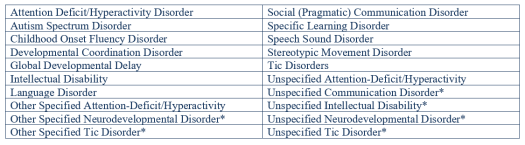
Neurodevelopmental list

*We will not cover the unspecified or other specified disorders in this blog.

We have filibustered enough! Here are the specifics!

Attention Deficit/Hyperactivity Disorder

Most of us know someone who exhibits the characteristics of Attention Deficit/Hyperactivity Disorder, or ADHD.  We are sometimes quick to call a friend or even a child showing high energy in the store ADHD.  However, simply having high energy does not qualify someone for the diagnosis.

The DSM-5 characterizes Attention Deficit/Hyperactivity Disorder as a “persistent pattern of inattention and/or hyperactivity-impulsivity that interferes with functioning or development” (Diagnostic and Statistical Manual of Mental Disorders, 2013).  This interference has to disrupt the individual in more that one area of their life.  Someone would need to be impulsive and/or hyperactive during play, while at home, and/or at work.

Criteria for Diagnosis

There are known milestones and developmental patterns that set a standard for ‘normal’ behavior.  It is normal for a toddler to run around, open and close cabinet doors, and throw temper tantrums.  This is why symptoms of inattention along with hyperactivity and impulsivity must be inconsistent with the individual’s developmental level.  In addition, the symptoms must be present prior to the age of twelve, they must be persistent for at least six months, and they must also negatively impact the individual in multiple settings, such as social, academic, or occupational (Diagnostic and Statistical Manual of Mental Disorders, 2013).

Symptoms of inattention include, but are not limited to, maintaining attention during activities, being easily distracted, trouble organizing, and not completing series of instructions.  Talking excessively, interrupting conversation, and fidgeting are symptoms that describe hyperactivity and impulsivity.

Autism Spectrum Disorder

Television shows like ABC’s The Good Doctor and Boston Legal, and Netflix’s Atypical depict a main character that is on the autism spectrum.  While each of these show’s main characters describe themselves as having Asperger’s Syndrome, it is no longer a separate diagnosis, but is now included as part of the autism spectrum.

Individuals with Autism Spectrum Disorder have “persistent deficits in social communication and social interaction across multiple contexts”, and they exhibit “restricted, repetitive patterns of behavior, interests, or activities” (Diagnostic and Statistical Manual of Mental Disorders, 2013).  It appears like the person is having difficulty carrying a conversation forward, or having the inability to shift behavior in different social situations, or trouble combining verbal and nonverbal communication.

Criteria for Diagnosis

There are five criterions for diagnosis with Autism Spectrum Disorder.  The first criterion for Autism Spectrum Disorder involves deficits in social communication and social interactions.  These deficits must be seen in three specific areas.  One: nonstandard back and forth conversation, and failure to begin or failure to respond to social interactions; two: “poorly integrated verbal and nonverbal communication”, which ranges from inconsistent eye contact and misunderstanding hand gestures to “a total lack of facial expressions”; and third: “deficits in developing, maintaining, and understanding relationships” (Diagnostic and Statistical Manual of Mental Disorders, 2013).

The second criterion involves limited, “repetitive patterns of behavior, interests, or activities” (Diagnostic and Statistical Manual of Mental Disorders, 2013).  The DSM-5 describes four examples of these patterns.  An individual only needs to exhibit two of the four in order to meet this criterion.   These include: repeating the same movements, having habitual verbal and nonverbal patterns, incredibly fixated interests, and abnormal “interest in sensory aspects of the environment” (Diagnostic and Statistical Manual of Mental Disorders, 2013).

The last three criteria are as mentioned in the introduction of neurodevelopmental disorders.  The symptoms must be present during early development; they must cause functional limitations in more than one area of life; and, they must not be better explained by another disorder. 

Global Developmental Delay

Global Developmental Delay is considered the failure to “meet expected developmental milestones in several areas of intellectual functioning” specifically in children who are five years and younger (Diagnostic and Statistical Manual of Mental Disorders, 2013).

The Centers for Disease Control have a checklist of milestones for children from two months to five years old.  Click HERE to check out their .pdf. (You will be leaving Collaborative Means’ webpage and directed to an extension of http://www.cdc.gov).

Criteria for Diagnosis

Diagnosis of Global Developmental Delay is reserved for individuals five years old and younger.  Assessment of children this age and younger is not considered reliable; therefore, this diagnosis is given until the severity of their symptoms can be more accurately determined.  It is expected that the individual be reassessed as they age.

Intellectual Disability

Intellectual Disability is one of the most stigmatized mental health diagnoses.  It has undergone multiple name changes in an effort to transform the public’s perspective of this disorder.  In fact, referring to an individual as ‘mentally retarded’, which was one of Intellectual Disability’s former names, is now considered both offensive and taboo.

Intellectual Disability, which is sometimes referred to as Intellectual Developmental Disorder, is characterized by “both intellectual and adaptive functioning deficits in conceptual, social, and practical domains” (Diagnostic and Statistical Manual of Mental Disorders, 2013).

Criteria for Diagnosis

There are three diagnostic criteria for Intellectual Disability.  First, the individual must have deficits in typical mental abilities such as abstract thinking, learning from experience, reasoning, and problem solving (Diagnostic and Statistical Manual of Mental Disorders, 2013).  Second, these deficits or impairments must inhibit the individual’s adaptive functioning.  It is important to note that the degree of hindrance is based upon the “individual’s age, gender, and [culture]” (Diagnostic and Statistical Manual of Mental Disorders, 2013).  Finally, the onset of this disorder is in the developmental period, which is a criterion for all of the neurodevelopmental disorders.

Specific Learning Disorder

Dyslexia, dysgraphia, and dyscalculia are disorders that seem to be ‘common place’.  Instead of having their own DSM-5 diagnoses, their characteristics are described as criteria for Specific Learning Disorder.

Specific Learning Disorder can be generalized as an individual having difficulties learning academics.  These include trouble spelling, writing, and solving math problems.  At some point in life, we all had difficulties in one or more of those areas, but the difference between having short-term issues with a subject and Specific Learning Disorder are great.

Criteria for Diagnosis

There are four diagnostic criteria for Specific Learning Disorder.  First, the individual must experience at least one of six symptoms for at least six months, and persistently.  These symptoms are difficulties with spelling, mastering sequences, writing, reading comprehension, mathematical reasoning, and “inaccurate or slow and effortful word reading” (Diagnostic and Statistical Manual of Mental Disorders, 2013).  Second, the individual must be performing significantly below what is expected for their level of development and in the academic area that is affected.  It is important to note that the level of performance must be based on the results of a test or assessment.  Third, the symptoms begin while the person is in early education.  Sometimes the symptoms are not present until the individual has been challenged academically, which can delay diagnosis.  Fourth, the learning difficulties must not be better explained by other neurodevelopmental disorders.

Up Next!

Part Two of Neurodevelopmental Disorders!

References

Definition of Intellectual Disability. (n.d.). Retrieved January 2, 2018, from http://aaidd.org/intellectual-disability/definition#.WmO8rSgx9SV

Diagnostic Adaptive Behavior Scale. (n.d.). Retrieved January 22, 2018, from https://aaidd.org/intellectual-disability/diagnostic-adaptive-behavior-scale#.WmZ4aKinHIU

Diagnostic and Statistical Manual of Mental Disorders, Fifth Edition. Arlington, VA, American Psychiatric Association, 2013. Web. [access date: 6 January 2018]. dsm.psychiatryonline.org

Mental Health Diagnoses?

We are ready to kick off our first blog series: Mental Health Diagnoses!  We will be covering eighteen of the nineteen classes in the Diagnostic and Statistical Manual of Mental Disorders 5.  Before we get started, let us cover some general background information.

What is the purpose of the Diagnostic and Statistical Manual of Mental Disorders 5?

The current edition of the Diagnostic and Statistical Manual of Mental Disorders 5 (DSM-5) was published in 2013.  The American Psychiatric Association developed this manual along with the previous editions.  The manual is meant to assist helping professionals accurately diagnose clients.  Accurate diagnosis safeguards the selection of appropriate clinical assessments and the development of applicable treatment plans.

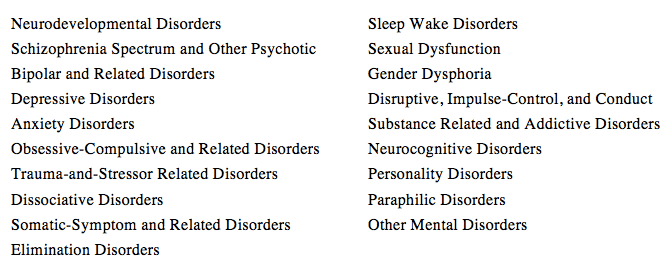
What are the classes of disorders listed within the DSM-5?

Screen shot 2018-01-07 at 8.29.38 PM

How does diagnosis using the DSM-5 work?

First, the manual defines the major classes of disorders.  Then, each individual disorder is distinguished through specific characteristics or criteria.  The manual goes on to describe diagnostic features; prevalence; development and course; risk and prognostic factors; gender and culture related diagnostic issues; diagnostic markers; differential diagnosis; and comorbidity for each disorder (Diagnostic and Statistical Manual of Mental Disorders, 2013).

Diagnosis depends on the individual meeting the minimum criteria, or characteristics, specific to each individual disorder.  Diagnoses can be further specified based on the presence and/or the severity of additional symptoms.  Some of these specifications include mild, moderate, or severe; with mixed features; in full remission; and so forth.  “Each disorder is accompanied by an identifying diagnostic and statistical code, which is typically used by institutions and agencies for data collection and billing purposes” (Diagnostic and Statistical Manual of Mental Disorders).  When an individual meets the majority of the criteria for a diagnosis, but not all of them, “provisional” is added to the end of the diagnostic code.  This diagnosis continues to be provisional until additional information is gathered, more time has passed, or whatever required condition is met in order to confirm the diagnosis.

Let us consider Major Depressive Disorder, or MDD.  The DSM-5 categorizes MDD through five main Criterion, A through E, with Criteria A having nine sub-criteria. In order to diagnose an individual with Major Depressive Disorder, they have to meet five of the nine sub-criteria listed under Criteria A in addition to meeting the characteristics described in Criterion B through E.  MDD can be further specified as mild, moderate, or severe.

What classifies something as a mental disorder?

The American Psychiatric Association classifies mental disorders as “a syndrome characterized by clinically significant disturbance in an individual’s cognition, emotion regulation, or behavior that reflects a dysfunction in the psychological, biological, or developmental processes underlying mental functioning. Mental disorders are usually associated with significant distress or disability in social, occupational, or other important activities” (Diagnostic and Statistical Manual of Mental Disorders, 2013).

What is mental wellness?

The World Health Organization defines mental heath as “a state of well-being in which every individual realizes his or her own potential, can cope with the normal stresses of life, can work productively and fruitfully, and is able to make a contribution to her or his community (Mental Health, 2014).  Notice that this definition allows wellness to be based upon an individual and not a collective group.  Wellness is a fluid personal venture.

What should I expect from this blog series?

• How the class of disorders is defined

• Names of the disorders within the class

• Descriptions of the disorders within the class

• Criteria for Diagnosis

• Differential Diagnosis

What is a Differential Diagnosis?

Differential diagnosis is the process of distinguishing one disease or disorder from other diseases or disorders that have similar characteristics.  This process is important for accurate diagnosis, which is paramount for developing suitable treatment plans and selecting the most fitting clinical assessments.

Why blog about mental disorders?

Significant stigma surrounds mental health including, but not limited to, mental health diagnoses, psychopharmaceuticals, and attending counseling sessions. Collaborative Means wants to share information on diagnoses, mental illness, and mental wellness in hopes that the information shared will inspire others to also share information and eventually stop the stigma.

There is more than one type of helping professional?

Click HERE to read our post, which describes four types of helping professionals:  counselors, psychiatrists, psychologists, and social workers.

DISCLAIMER

This blog series is intended to give clear information on the mental disorders listed in the Diagnostic and Statistical Manual 5.  This information is not intended to be a substitute for counseling, nor medical advice, nor professional opinions.  This article does not create a counselor-client relationship.  Information in this blog should not be used to diagnosis yourself or others.  If you think you may exhibit characteristics of any mental disorder, you should seek the aid of a helping professional.

Up Next!

Our first Mental Health Diagnosis article will cover Neurodevelopmental Disorders!

References

Diagnostic and Statistical Manual of Mental Disorders, Fifth Edition. Arlington, VA, American Psychiatric Association, 2013. Web. [access date: 31 December 2017]. dsm.psychiatryonline.org

Mental health: a state of well-being. (2014, August). Retrieved December 29, 2017, from http://www.who.int/features/factfiles/mental_health/en/

Types of Helpers

Psychiatrists, psychologists, social workers and counselors are examples of helping professionals.  Helping professionals treat persons who are mentally ill, who are feeling overwhelmed by the stressors of life, and who fluctuate between declining and thriving mental health, and/or other mental and emotional concerns.  If each of these types of helping professionals can do all of these things and more, how are they different?  Each profession is distinguished by their educational requirements, mission, and licensing scope of practice.

Psychiatrists are licensed medical doctors.  They accomplished specified undergraduate course work for entrance into medical school, earned a medical degree, completed four years of residency, and acquired licensure and board certification in order to practice.  Psychiatrists are currently the only helping professionals legally approved to prescribe psycho-pharmaceuticals.  Psychiatrists mainly treat persons with mental illnesses who require prescription medication to manage their symptoms.  Psychiatrists along with other helping professionals see clients, who are sometimes referred to as patients.

Psychologists provide mental health care by evaluating, testing, diagnosing and treating persons with mental and behavioral deficits.  Eligibility to practice as a psychologist requires a minimum of a graduate level degree in one of the many areas of psychology:  forensic, clinical, organizational, counseling, and behavioral.  The terminal degrees for psychologists are a Doctor of Philosophy, PhD, or a Doctor of Psychology, which is known as a PsyD.  As with all helping professions, each state has specific requirements for licensure.  Helping professionals sometimes refer clients to psychologist for testing including but not limited to aptitude, achievement, intelligence, and neuropsychological.

Social workers are advocates and liaisons.  Their focus ranges from client education and counseling to connecting the client to public and community resources.  Social workers must earn a degree in social work and earn a passing score on licensure exams.  Persons completing a Bachelor’s Degree may obtain an Initial License and persons completing a Master’s Degree may obtain a Master License.  Clinical Social Workers have completed supervised clinical experience in addition to earning a Master’s Degree in social work.  This Clinical License allows social workers to provide individual mental health counseling services to clients.

Counselors practice from a wellness perspective.  Counselors make a point to understand their client’s cultural, ethnic, and socioeconomic context in order to help their client navigate through mental health and/or life issues so they ultimately live well.  Counselors have earned a Master’s Degree in a counseling related field, including but not limited to community counseling, clinical mental health counseling, and vocational rehabilitation.  Counselors must obtain a license from their respective state in order to see clients.  To learn more about the counselor licensing process, check out our blog post “The I in LPC-I?”

The “I” in LPC-I

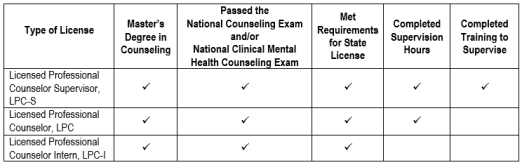
Although LPC, LPC-I, and LPC-S look like limited letter alphabet soup, each abbreviation designates the qualifications of the counselor.  LPC stands for Licensed Professional Counselor.  Licensed Professional Counselors have earned a Master’s degree in the field of counseling, passed the National Counseling Exam and/or the National Clinical Mental Health Counseling Exam, applied for and met the requirements for their respective state’s licensure process, and they have completed their state’s required hours of supervision.  Licensed Professional Counselor Supervisors, or LPC-S, have completed the same requirements as an LPC as well as the requirements necessary to supervise the work of other Licensed Professional Counselors.

The “I”, which stands for intern, in LPC-I is the designation used by the Labor Licensing and Regulation Board of South Carolina to differentiate licensed counselors who earned their Master’s degree in the field of counseling, passed the National Counseling Exam and/or the National Clinical Mental Health Counseling Exam, applied for and met the requirements for the state’s licensure process, but have not yet completed the state’s required hours of supervision.  Counselors are required to spend a minimum of two years completing supervision hours.  Supervision ensures that each client receives thorough evaluation, and optimal treatment.

lpc chart2